How-to
How to Remove Running Boards and What to Do With the Factory Holes
To remove running boards, have a helper hold the board, take out the bolts between board and brackets, then unbolt the brackets from the truck. We found no maker sheet with a removal procedure, so this comes from reading install sheets backward. Factory holes and studs can stay as they are. Holes that were drilled need paint or sealing, and power steps need the wiring undone first.
Straight answer
Get a helper and your install sheet. Take the bolts out between the board and the brackets, lower the board, then unbolt the brackets. Refit any plastic plugs over factory threaded holes. Paint bare metal in any drilled hole. On a power step, pull the fuse and undo the wiring first. No maker sheet we read gives a removal procedure.
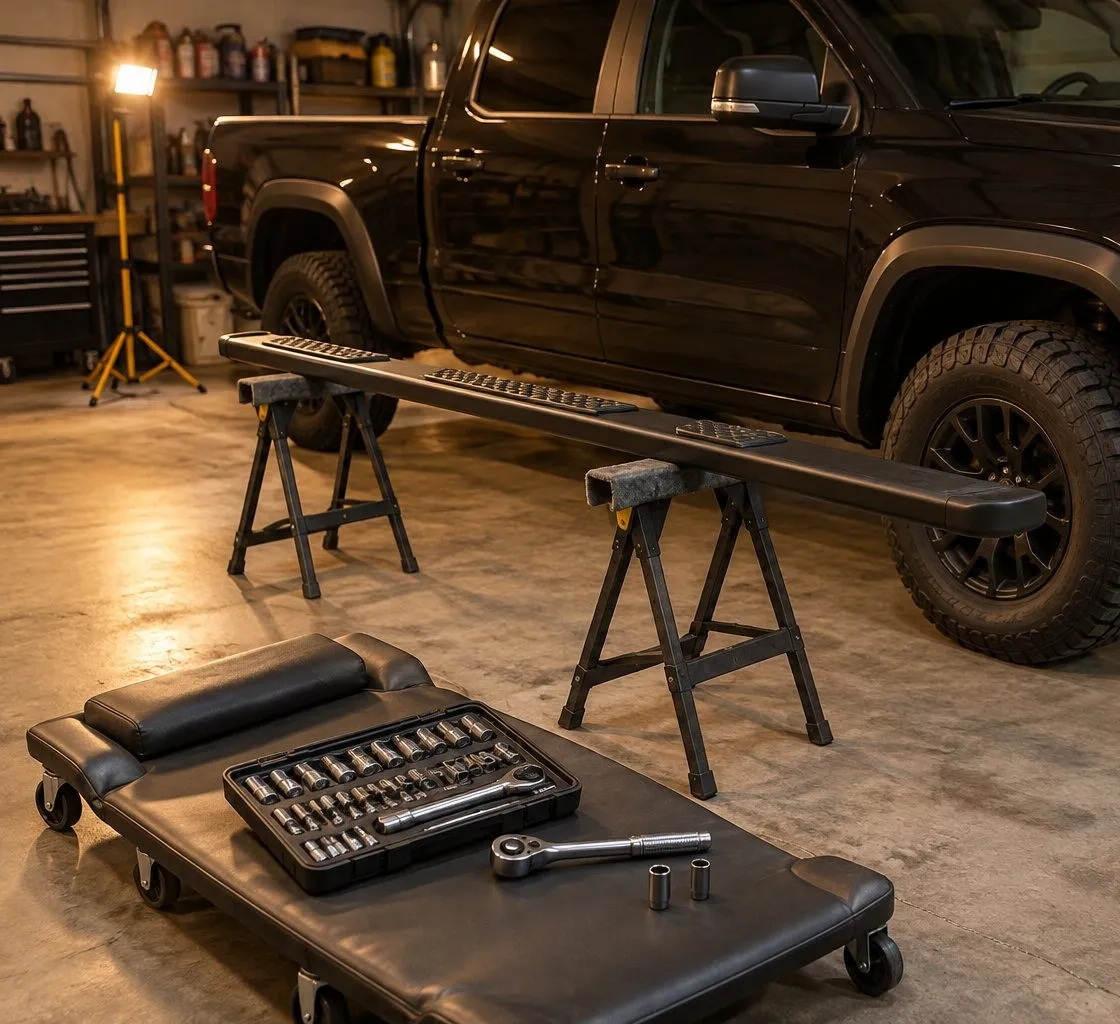
A running board is a step mounted below a truck's doors that makes it easier to climb in and out. Taking one off is mostly a socket-and-helper job, but say this up front: none of the maker sheets we read includes a removal procedure. They only cover going on. So we are working from how those sheets say the parts go together, and your own sheet beats anything here. Nobody on this site has pulled these off a truck. We give no time, because no sheet gives one for removal.
What to have on hand
- Your install sheet. Get the sheet for your part number, or the closest one the maker has. How to install running boards shows what those sheets look like.
- Sockets to match the hardware. Most of the Tyger hardware we read is 8mm. Check yours.
- A helper. Tyger's sheets say assistance is recommended for putting a board on. It weighs the same coming off.
- Eye protection. Westin's sheet says to always wear safety glasses or goggles, and AMP's tool list starts with safety goggles.
- A bag for hardware, if the board might go back on or get sold.
Taking it off
Get the sheet and a helper
Read your sheet from the last step to the first. That is your order of work. Have your helper take the weight of the board before any bolt comes out.Cut power on a power step
Skip this on a fixed board. On a power step, RealTruck's guides have you remove the fuse from the step's wire harness during the install, so pull it first. Then undo what the guide added: the battery leads, the OBD II plug, the wire taps and the motor connections.Take the board off the brackets
On the Tyger sheets, 8mm combo bolts hold the sidebar to each bracket. Take them out and lower the board straight down. Tyger warns against twisting or sliding the bar on the brackets, or the finish may suffer, so do not drag it off.Unbolt the brackets
How they come off depends on the mount. On TG-SS2D35098, each bracket sits on 3 factory studs with nylon lock nuts and flat washers. On TG-SS2C35068, each has hex bolts into threaded holes in the body.Deal with what is left
Work through the table below, one mount at a time.Repeat and inspect
Do the other side. Then look over the rocker and the pinch weld while you can still see them clearly.
Removing a factory board? We read no Ford, GM or Ram removal procedure, so ask your dealer or get the factory service manual. Westin's sheet for its 2023-up Ford side bed step does have a remove-the-OEM-step line, followed by the factory bolts, but it covers that step and nothing else.
What to do with the factory holes
This is what most people are really asking. It depends on what your kit used.
| What you find | Where we read about it | What to do |
|---|---|---|
| Threaded holes that had plastic plugs | TG-SS2C35068: "Remove the plastic plugs from each mounting location" | Put the plugs back if you kept them. If not, ask a dealer for replacements |
| Factory studs | TG-SS2D35098: 3 factory studs per bracket | Nothing to fill. The studs stay on the truck |
| Plastic retainers on studs | TG-RS6F60118, the F-150 sheet: they go between the aluminum panel and the steel brackets | Keep them with the part if it may go back on |
| Holes drilled through the pinch weld | AMP 76255-01A: "apply paint to holes to prevent rusting" | Check that the paint is intact, and touch it up where it is not |
| LED wire holes with grommets | AMP 76152-01A: grommet in a 19/64-inch hole | Decide whether to leave the grommet in or have the hole closed |
| A floor hole on a SuperCab | AMP 76152-01A: 9/32-inch hole with grommet and silicone sealant | Keep it sealed, and have a shop close it if you want it gone |
We found no maker instructions for filling a drilled hole, so we will not give you a recipe. If you want a hole gone rather than sealed, that is a question for a body shop. Show them the sheet so they know what was drilled and where. Can you install running boards without drilling? shows which kits drill in the first place.
If the part is going back on, or to someone else
- Going back on. Treat it like a new install, with the same torque values. RealTruck's warning says to re-check that the product is properly installed "after installing or reinstalling".
- Going to someone else. RealTruck's AMP warranty applies to the original purchaser only, so do not sell it as coming with one. Pass on the sheet, the hardware and any retainers.
- Being replaced. A new part has its own sheet, and it may not use the same mounts. Read that sheet before you take off the old one. Running board brackets covers the hardware side, and best running boards is where we compare what to replace it with.
Warranty
Ford says an aftermarket product "will not necessarily void" its warranty, but repairs are not covered if the product fails or causes another part to fail. So if you find damage when the board comes off, take photos before anyone fixes it. Do running boards void your warranty has more, and none of it is legal advice.
Other trucks and their parts are listed under all trucks, and how we read every sheet is on how we verify fitment.
Tailgate questions
Can you remove running boards and leave them off?
We found nothing in the sheets we read that says the truck needs them. Tyger's sheets use existing threaded holes or factory studs, so those stay on the truck when the board comes off. If your kit drilled holes, those need dealing with. Check your own truck's paperwork if the boards were factory equipment.
Should I plug the holes after removing running boards?
If they are factory threaded holes that had plastic plugs, yes, put the plugs back if you kept them. Tyger's sheet for TG-SS2C35068 has you take those plugs out, and it says nothing about what comes after. For drilled holes, RealTruck says to apply paint to holes to prevent rusting. Beyond that, ask a body shop.
Does removing running boards void my warranty?
We found nothing saying that taking a part off does. Ford's page deals with aftermarket parts that fail or damage something, and says those repairs are not covered. So keep records of any damage you find when the board comes off. This is not legal advice. Ask your dealer about your truck's terms.
Can I reinstall running boards after taking them off?
Follow the install sheet as if the part were new, and keep every piece of hardware. RealTruck's warning covers installing or reinstalling, and it says to re-check that the product is properly installed. Tyger's sheets also ask for periodic checks that all hardware stays secure and tight.
Where this comes from
- Tyger Auto instruction sheet TG-SS2C35068 (PDF hosted by CARiD)
- Tyger Auto instruction sheet TG-SS2D35098 (PDF hosted by CARiD)
- RealTruck AMP Research installation guide IM76255 (PDF)
- RealTruck AMP Research installation guide IM76152, F-150 2021-2026 (PDF)
- Westin Automotive: HDX and Grate side bed step instructions (PDF)
- Ford: will aftermarket modifications void my warranty?
Keep reading
- How-toHow to installHow to install running boards from the maker sheets: find the mounting points, hang brackets loose, level, torque, and when a kit really does need a drill.
- How-toBrackets and boltsRunning board brackets and bolts: why brackets are truck-specific, maker bracket numbers by truck, bolts on the sheets, and how to replace a bracket.
- ComparisonBest running boardsThe best truck running boards are the ones listed for your year and cab. Our picks by truck and use, with no lab scores, only published fit and maker sheets.
- Question & answerCan You Install Running Boards Without Drilling? The Parts and Years That Still Need HolesMany running boards bolt on with no drilling, but not all. Which maker sheets have no drilling step, and which Tyger, AMP and Carr parts call for holes.
- Question & answerDo Aftermarket Running Boards Void Your Truck's Warranty? What the FTC, Ford and Ram SayDo running boards void a truck warranty? What the FTC, Ford and Ram's own booklet state, what stays uncovered if a part does damage, and what we could not read.
- About usHow we verify fitFit here is what a listing title or maker sheet states, marked as such. What we read, what blocked us and why you still confirm year and cab before you buy.
Who writes this
runningboardsfortrucks.com Editorial Team
Fitment, buying advice and explainers
We are the editorial team at runningboardsfortrucks.com. We read listing titles, maker pages and instruction sheets, then write down which truck, year and cab each one states and where we read it. We do not run lab tests and we do not own a test fleet, and we say so openly.
- Fit quoted from the listing or maker
- Sources and dates on every page
- No lab tests, stated openly
- Publisher details in the imprint