Question & answer
Do Running Boards Rust? Steel, Aluminum and Stainless in Road Salt
Yes, some can. Steel rusts once salt and water reach bare metal, stainless can stain and corrode in road salt, and aluminum does not form rust but still corrodes. We found no published corrosion test of truck running boards, so nobody can honestly promise you a number of winters. Your best tools are the finish, the warranty's fine print and a hose.
Disclosure: This page contains affiliate links (marked with *). If you buy through them, we earn a small commission at no extra cost to you. As an Amazon Associate I earn from qualifying purchases. Learn more
The straight answer
Yes. Steel boards can rust where the coating is broken, and salt speeds it up. De-icing salt can stain even Type 304 stainless. Aluminum forms no rust, but dissolved chlorides corrode it. We found no corrosion test of running boards, and none is rust-proof, whatever a title says. Wash the salt off and paint any bare metal.
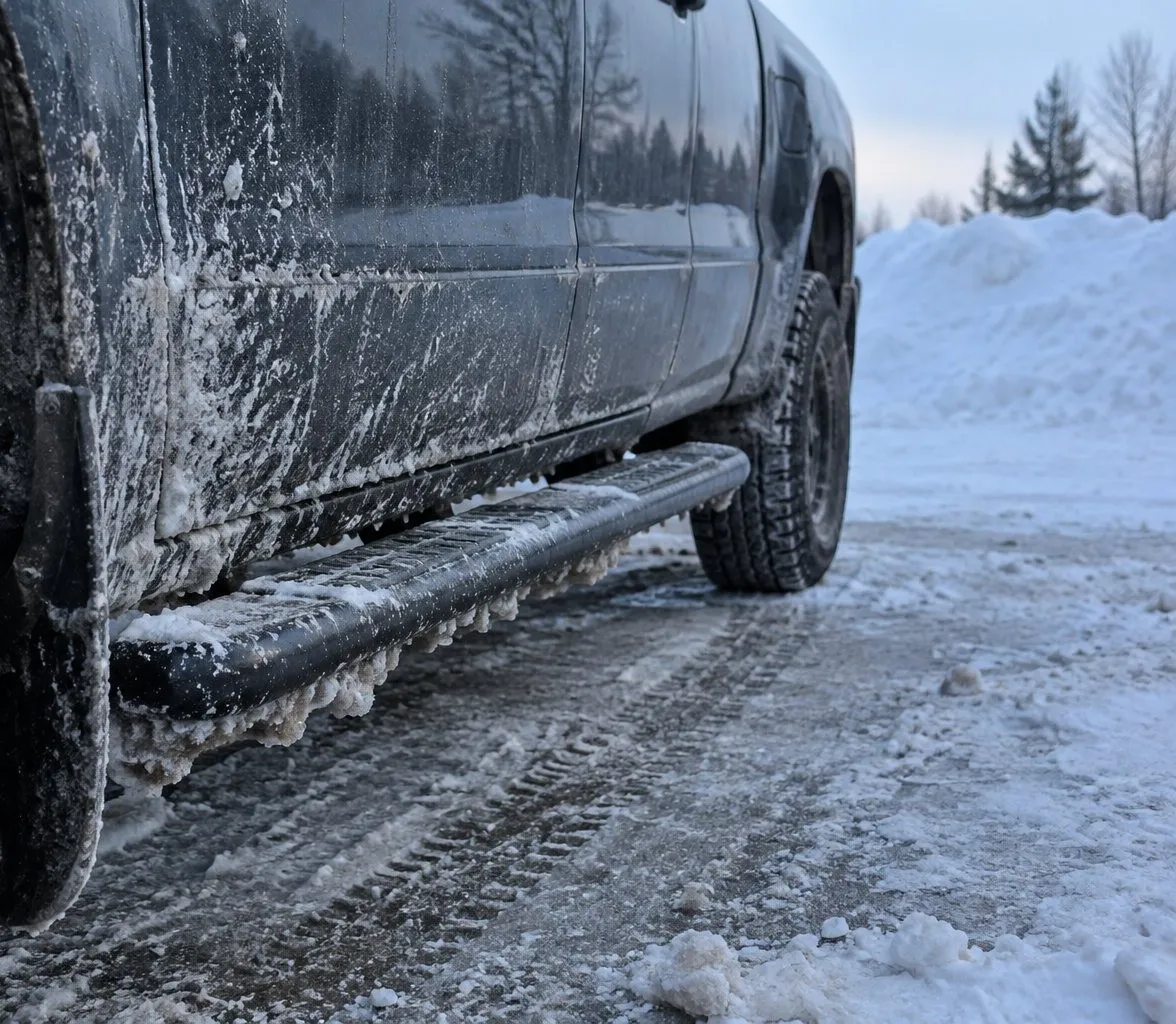
The sales pitch says the metal solves it. The paperwork is less sure. Here is what the sources support, metal by metal, and what we could not find.
What each material actually does
| Material | Does it rust? | What we read |
|---|---|---|
| Coated carbon steel | Yes, once water and salt reach bare steel | Wikipedia: rust is iron oxides, and salt makes iron rust more quickly. Westin sells its steel Grate Steps with an e-coated base and textured black finish |
| Stainless steel | It can stain and corrode | De-icing salt causes at least superficial staining on Type 304 and less-resistant grades, per the Construction Specifier. Aalco's datasheet does not recommend 200-series grades for chloride environments |
| Aluminum | No rust, but it corrodes | Wikipedia: a thin oxide layer protects it, and dissolved chlorides such as sodium chloride still corrode it |
| Chrome-plated steel | It can, if the plating fails | Tyger's chrome trim warranty speaks to defects that make the product "peel off or rust" |
The stainless source is about building railings, not truck parts, but salt is salt. Its other useful finding: smooth finishes hold less salt and rinse clean more easily than rough ones. Which metal beats which on a running board is a question for our aluminum vs stainless comparison, and the short version there is that no test we found settles it. The details by metal are on aluminum running boards and stainless steel running boards.
Where the paperwork tells you to watch
The tread gets the marketing. The sheets worry about the joints and the cuts.
- Holes you drill. RealTruck's guide for the AMP PowerStep 76254-01A has you drill 19/64-inch holes through the pinch weld for the light wires, deburr them, then "apply paint to holes to prevent rusting".
- Metal you cut. Rough Country's sheet for its 2007-2018 Chevy and GMC kit has you notch a parking brake bracket on 2007-2013 models, then sand and paint it to reduce rust.
- Steel against aluminum. Tyger's sheet for TG-RS6F60118 on the F-150 uses plastic retainers it says are "designed to prevent corrosion between the aluminum body panel and the steel mounting brackets". It tells you not to install the brackets without them.
- Chips. Tyger's warranty on its Riser boards leaves out damage from road hazards such as gravel. So a chipped coating from a gravel road is yours to deal with.
Tyger Auto
Tyger Riser 6" (F-150 SuperCrew)
A 6-inch step with a maker sheet that deals with Ford's aluminum body.
Why here: Its sheet is the one maker document we read that spells out how a board install guards against corrosion at the body.
- Fits, according to the listing
- 2015-2027 Ford F-150; 2022-2025 F-150 Lightning; 2017-2027 F-250 F-350 SD | Supercrew Cab (as of November 2, 2026)
- Style
- Running board / step bar (as titled)
- Material
- Not stated in the title
- Weight rating
- Not stated in the title
- Install
- Bolt-on to factory studs with plastic retainers; no drilling step in the sheet; assistance recommended
- Price class
- Mid-range
Check your exact year and cab on the listing before you buy.
Why it makes the list
- Part number (TG-RS6F60118) ties it to Tyger's instruction sheet
- Sheet uses plastic retainers to prevent corrosion between the aluminum body panel and steel brackets
- No drilling step in the sheet
Watch out for
- Not for the SuperCab per the title
- No weight rating in the title, so none is printed here
- The sheet says to clear paint or undercoating from the studs first
Best for: SuperCrew owners on the 2015-up F-150 who want a wide step and a clear install sheet.
That box is the F-150 SuperCrew part, as its title states. For other trucks, the same question is worth asking the seller. Check your exact year and cab on the listing before you buy.
What a warranty will and will not say
Read the warranty, not the bullet points. Two examples from makers:
| Maker | What it advertises or covers | The fine print |
|---|---|---|
| LUVERNE | The catalog calls Grip Step "rust-free" | The warranty excludes damage from "corrosion, rust formation" and from road hazards |
| Tyger | Riser boards: 5 years on black e-coat, limited lifetime on the stainless finish, for defects in materials, workmanship and finish | Road hazards excluded. On chrome trim, it says letting salt stick to the product "will void your warranty" |
That chrome line covers one Tyger product group, not every part it sells. And Tyger's terms do not name every line, so ask about yours. One WOLFBOX title for F-150 power boards uses the word Rust-Proof. Nothing in the title backs it, and we found no test that does. On this site we say corrosion-resistant, never rust-proof.
How to slow it down
None of this comes with a promise on any part's lifespan. These are care steps the makers themselves print.
Wash the salt off
Go Rhino's sheets say to wash often in cold areas to remove harmful materials used on roadways, then dry all surfaces.Use gentle stuff
Go Rhino says no abrasive cleaners or polish compounds, only gentle soap and water. Westin's sheets recommend regular waxing with a non-abrasive wax.Seal what you cut
Paint drilled holes and cut edges, as the AMP and Rough Country sheets say. Use the grommets and sealer the kit calls for.Keep the insulators
Fit every plastic retainer or washer that came in the box. How to install running boards covers the rest of the job.Look underneath
Check the brackets and the fasteners when you wash the truck. Tyger's sheets call for periodic inspections anyway.
What we could not find
We found no salt-spray hours, no corrosion measurements and no independent winter durability test for any truck running board. If a seller quotes a lifespan, ask where it comes from. If you are worried about warranty on the truck itself, a rusted aftermarket bracket is a different matter from the truck's coverage, so see do running boards void your warranty.
Our picks by truck are on best running boards, and the home page sorts parts by your truck.
Tailgate questions
What kind of running boards don't rust?
None we can promise that for. Aluminum does not form rust, which is iron oxide, but chlorides corrode it. Stainless resists better than plain steel, yet de-icing salt can stain Type 304. Coated steel holds until the coating is breached. We found no road-salt test comparing them on a running board, so judge the finish and the warranty.
Are rust-proof running boards really rust-proof?
Treat it as seller wording. One WOLFBOX title says Rust-Proof, with no test or standard behind it in the title. LUVERNE's catalog calls Grip Step rust-free, while its warranty excludes damage from corrosion and rust formation. Read the warranty, because that is the part a maker has to stand behind.
Do running boards make your rocker panels rust?
We found no measurement either way. What the paperwork does show is that the joints deserve care. Tyger's F-150 sheet uses plastic retainers between steel brackets and the aluminum body panel to prevent corrosion, and RealTruck's AMP guide says to paint any hole you drill. Look under there when you wash the truck.
Where this comes from
- Tyger Auto instruction sheet TG-RS6F60118 (PDF hosted by CARiD)
- AMP Research installation guide 76254-01A (PDF hosted by CARiD)
- Construction Specifier: Avoiding de-icing salt corrosion (Catherine Houska, January 5, 2015)
- LUVERNE: limited warranty, effective June 1, 2025 (PDF)
- Tyger Auto: warranty terms (PDF hosted by CARiD)
- Go Rhino instruction sheet 69404887T, RB20, Silverado 1500 Crew Cab (PDF hosted by CARiD)
Keep reading
- ComparisonAluminum vs stainlessAluminum vs stainless steel running boards: what salt does to each, how much lighter aluminum is, where coated steel fits, and what listing titles leave out.
- Buying guideAluminum running boardsAluminum running boards by truck and cab, with fit as each listing states it. What aluminum buys you on weight and road salt, and what the titles leave out.
- Buying guideStainless steel boardsStainless running boards by the grade actually named: 304, 201 or none. What road salt does to stainless, what chrome really is, and which boards fit which truck.
- How-toHow to installHow to install running boards from the maker sheets: find the mounting points, hang brackets loose, level, torque, and when a kit really does need a drill.
- Question & answerDo Aftermarket Running Boards Void Your Truck's Warranty? What the FTC, Ford and Ram SayDo running boards void a truck warranty? What the FTC, Ford and Ram's own booklet state, what stays uncovered if a part does damage, and what we could not read.
Who writes this
runningboardsfortrucks.com Editorial Team
Fitment, buying advice and explainers
We are the editorial team at runningboardsfortrucks.com. We read listing titles, maker pages and instruction sheets, then write down which truck, year and cab each one states and where we read it. We do not run lab tests and we do not own a test fleet, and we say so openly.
- Fit quoted from the listing or maker
- Sources and dates on every page
- No lab tests, stated openly
- Publisher details in the imprint