Comparison
Aluminum vs Stainless Steel Running Boards: Rust, Weight and What Titles Leave Out
Take aluminum if you want the lighter metal. Take stainless if you want a polished finish or a named grade. Neither is corrosion-proof, and salt attacks both. We found no road-salt test that puts the two side by side on a running board, so anyone naming a winner on rust is guessing. Weight, grade and warranty are what you can actually compare.
Disclosure: This page contains affiliate links (marked with *). If you buy through them, we earn a small commission at no extra cost to you. As an Amazon Associate I earn from qualifying purchases. Learn more
Straight answer
Aluminum is about one-third the density of steel, so it wins on weight. Stainless wins on paperwork when a maker names the grade, as Westin does with 304 on polished lines. Dissolved chlorides attack both, and we found no road-salt test comparing them on a running board. Pick by weight, finish and warranty, then check your exact year and cab on the listing.
What's on this page
Most comparisons of these two metals end with a confident winner. We could not find the data to back one up. Here is what the sources do support, and where the evidence stops. For the detail on one metal, go to aluminum running boards or stainless steel running boards.
The three metals side by side
Read November 2, 2026. The metal figures describe the material, not any board. The warranty row is one maker's terms, Westin's, because Westin sells the same style in more than one metal.
| Aluminum | Stainless steel | Coated steel | |
|---|---|---|---|
| Density | About 0.10 lb per cubic inch (2.70 g/cm³), about one-third of steel | About 0.27 to 0.29 lb per cubic inch (7.5 to 8.0 g/cm³) | Steel underneath; no figure read for the coating |
| What protects it | A thin oxide layer that forms in air | A passive film, which needs 10.5 percent chromium or more | The coating |
| What salt does | Dissolved chlorides corrode it, more so around dissimilar metals | Chlorides cause pitting; de-icing salt stains Type 304 at least superficially | No figures found for coated steps |
| Grade named in titles we read | None; "aluminum" only | Usually none; one title says 201 | Not in these titles |
| Westin example | Black aluminum R5: 3-year warranty | Polished 304 R5: lifetime warranty | Black e-coated PRO TRAXX: 3-year warranty |
| Price class of the Silverado listings below | Budget | Budget | No listing compared |
That last row surprises people. In the two Silverado listings below, stainless does not sit in a higher price class than aluminum. So the metal in the title is not a shortcut to quality in either direction.
Weight
Aluminum wins, and it is the one clear result on this page. But the real gap on a truck is unknown. No title we read gives a board weight, and a hollow board with a thin wall does not weigh what a solid block does. A wide aluminum board can also outweigh a narrow stainless tube.
So treat the density figure as a reason to expect less weight from aluminum, and not as a number for your truck. If weight matters, ask the seller for the shipping weight of the exact part.
Salt
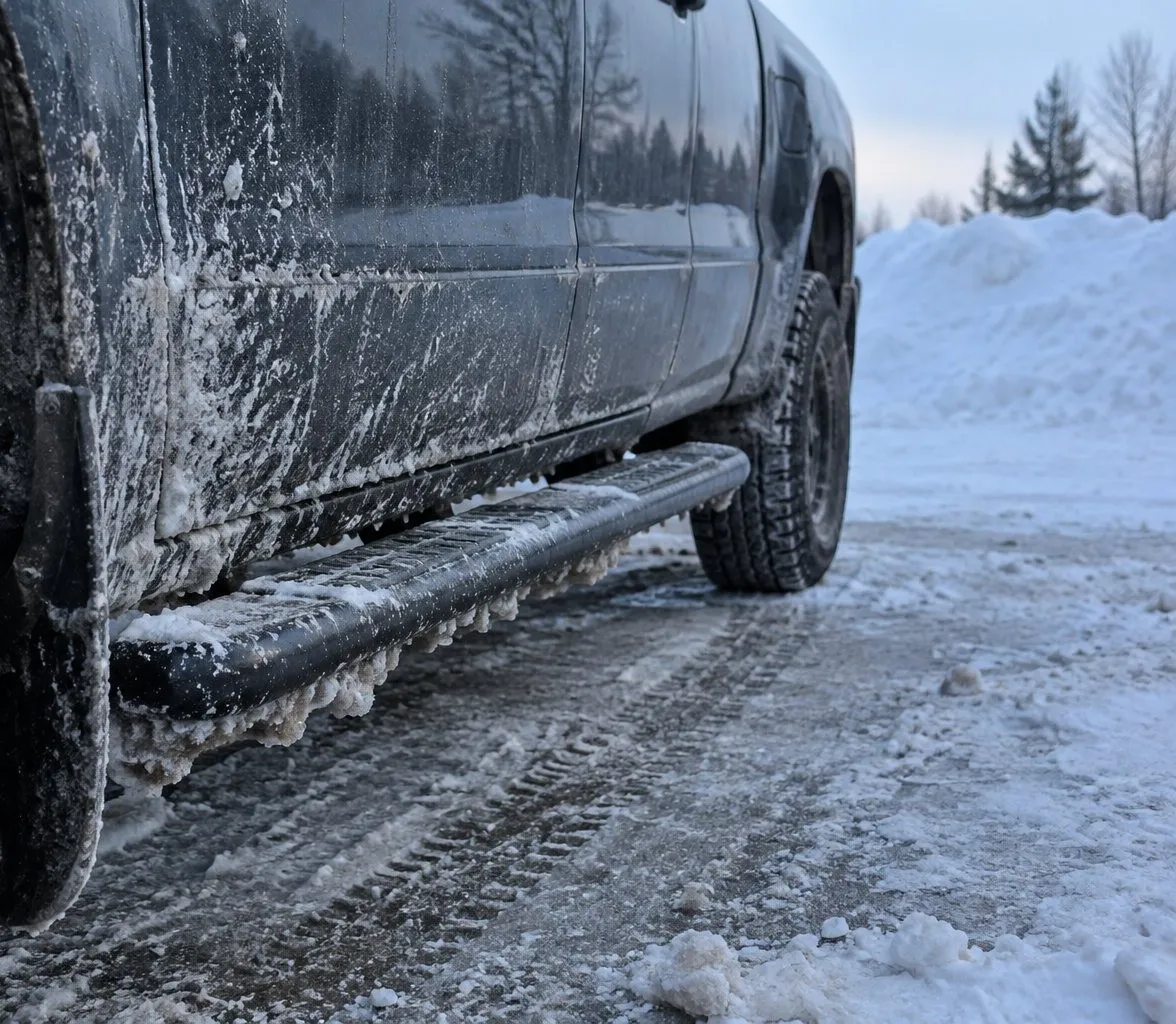
Aluminum. It protects itself with a thin oxide layer, but dissolved chlorides, common salt included, corrode it. Salt water makes that worse when dissimilar metals are in the picture. We found no road-salt measurements for aluminum boards.
Stainless. Chlorides are the known enemy here too. The Construction Specifier says de-icing salt causes at least superficial staining on Type 304 and less-resistant grades. It also says calcium and magnesium chlorides turn corrosive at about 32°F and roughly 45 to 50 percent relative humidity, so the problem does not wait for a warm day. That article is about building materials, not truck parts. Our stainless page goes through grades and what the 201 in one title means.
Coated steel. The coating does the work, so a chip in it is what to watch. We found no road-salt data on these either.
The fair summary: no source we read says one metal beats the other on a running board in salt. Our rust page covers the wider question. Whatever you buy, washing the salt off is the one habit every source supports.
Where metals meet
Galvanic corrosion needs two different metals, an electrical path between them and an electrolyte, and salty moisture is an electrolyte. When aluminum and steel are coupled, aluminum is the one that corrodes. The usual fix is to keep the metals electrically apart.
This shows up in real truck paperwork. Tyger's sheet for TG-RS6F60118 on the F-150 uses plastic retainers that it says are "designed to prevent corrosion between the aluminum body panel and the steel mounting brackets", and it tells you not to install the brackets without them. Rough Country's sheet for its F-150 and F-250 power step kit has you put a plastic insulator on each stud too.
So on an aluminum-body truck, the bracket-to-body joint matters whichever board metal you pick. An aluminum board on steel brackets raises the same question, and none of the sheets we read says how its board-to-bracket joint handles it. Do not throw out any plastic washer or retainer that came in the box.
Which one to buy
Tyger Auto
Tyger Rider 3.5" (2019+ GM)
A 3.5-inch rail whose title names the Silverado and Sierra years, the HD split and the cab.
Why here: It is the crew cab part here with a maker sheet we could read. Neither its title nor its sheet text names the metal, so it does not settle this debate, but you know how it mounts.
- Fits, according to the listing
- 2019-2026 Chevy Silverado GMC Sierra 1500; 2020-2027 2500 3500HD | Crew Cab (as of November 2, 2026)
- Style
- Rail / nerf bar (as titled)
- Material
- Not stated in the title
- Weight rating
- Not stated in the title
- Install
- Bolt-on with 8 brackets; no drilling step in the sheet; assistance recommended
- Price class
- Mid-range
Check your exact year and cab on the listing before you buy.
Why it makes the list
- The part number in the title (TG-SS2C35068) ties the listing to Tyger's own instruction sheet
- That sheet bolts 8 brackets to threaded holes behind plugs in the rocker area and has no drilling step
- Title separates the 1500 years from the 2500/3500HD years
Watch out for
- 3.5 inches wide per the title, narrower than the 6-inch boards
- No weight rating in the title, so none is printed here
- The title does not mention the 2019 LD/Limited; a sister Tyger listing groups that truck with the older body, so check before ordering
Best for: Crew cab owners on the 2019-up GM full-size who want a rail with a readable install sheet.
The Rider is our pick for a 2019-up Silverado or Sierra crew cab because of the paperwork, not the metal. If the metal is what you are shopping for, these two titles name it.
| Spec sheet | Our pick: Silverado and Sierra crewTyger Rider 3.5" (2019+ GM) | Listing data onlyAluminum nerf bars (2019+ Silverado and Sierra) | Listing data onlyCOMNOVA 6" Stainless (2019+ Silverado) |
|---|---|---|---|
| Fits, according to the listing | 2019-2026 Chevy Silverado GMC Sierra 1500; 2020-2027 2500 3500HD | Crew Cab | Crew Cab ... 2019-2026 Chevy Silverado & GMC Sierra 1500 (Excl 2019 Ld/Lt), 2020-2026 2500 HD 3500 HD | 2019-2026 Chevy Silverado 1500, 2020-2026 Silverado/Sierra 2500/3500HD Crew Cab |
| Style | Rail / nerf bar (as titled) | Running board / step bar (as titled) | Running board / step bar (as titled) |
| Material | Not stated in the title | Aluminum (title) | Stainless steel (title) |
| Weight rating | Not stated in the title | Not stated in the title | Not stated in the title |
| Install | Bolt-on with 8 brackets; no drilling step in the sheet; assistance recommended | Not stated in the title | Not stated in the title |
| Price class | Mid-range | Budget | Budget |
| Best for | Crew cab owners on the 2019-up GM full-size who want a rail with a readable install sheet. | GM crew cab owners who want aluminum and an explicit LD exclusion on the listing. | Silverado crew owners who want stainless named on the listing. |
| On Amazon(paid link to Amazon, opens in a new tab)Ad · paid link · check price & delivery on Amazon | On Amazon(paid link to Amazon, opens in a new tab)Ad · paid link · check price & delivery on Amazon | On Amazon(paid link to Amazon, opens in a new tab)Ad · paid link · check price & delivery on Amazon |
Read the fit lines closely. The aluminum title covers the Silverado and Sierra 1500 but excludes the 2019 LD/LT. The stainless title names the Silverado 1500 and leaves out the Sierra 1500. Check your exact year and cab on the listing before you buy. Other trucks have their own lists on the Silverado page and under all trucks.
If you want a maker sheet before you buy → Tyger Rider 3.5" (2019+ GM)
Fits, according to the listing: 2019-2026 Chevy Silverado GMC Sierra 1500; 2020-2027 2500 3500HD | Crew Cab. Check your exact year and cab on the listing before you buy.
View(paid link to Amazon, opens in a new tab)Ad · paid link · check price & delivery on AmazonIf you want aluminum named in the title → Aluminum nerf bars (2019+ Silverado and Sierra) · Listing data only
Fits, according to the listing: Crew Cab ... 2019-2026 Chevy Silverado & GMC Sierra 1500 (Excl 2019 Ld/Lt), 2020-2026 2500 HD 3500 HD. Check your exact year and cab on the listing before you buy.
View(paid link to Amazon, opens in a new tab)Ad · paid link · check price & delivery on AmazonIf you want stainless named in the title → COMNOVA 6" Stainless (2019+ Silverado) · Listing data only
Fits, according to the listing: 2019-2026 Chevy Silverado 1500, 2020-2026 Silverado/Sierra 2500/3500HD Crew Cab. Check your exact year and cab on the listing before you buy.
View(paid link to Amazon, opens in a new tab)Ad · paid link · check price & delivery on AmazonIf you want a named 304 grade
Take aluminum if you want the lighter metal or a black textured look suits you. Take stainless if you want polish, and shop for a named grade if you can get it. Take coated steel if the part you want comes that way, knowing the coating is what you are relying on. Westin's PRO TRAXX page gives its black e-coated steel 3 years against a lifetime on polished 304, and its R5 does the same between black aluminum and polished 304.
What about load? Metal does not tell you. The one rating we read in a maker document, 300 lbs. of weight capacity per side, sits on Westin's aluminum Pro-e. How much weight running boards can hold has the rest, and how we verify fitment explains why we print so few numbers.
Tailgate questions
Should I get aluminum or steel running boards?
Get aluminum if weight matters most, since its density is about one-third of steel's. Get stainless if you want polish or a named grade. Get coated steel if the part you want comes that way, and read the warranty, because Westin gives its black coated lines shorter terms than its polished stainless. No test we found settles rust between them.
Which is better, aluminum or stainless steel running boards?
Neither across the board. Aluminum is the lighter metal. Stainless comes with a named grade on some maker lines, and Westin backs its polished 304 with a lifetime warranty on the pages we read. Salt can attack both. We found no independent test of the two on a running board, so buy on the things you can check.
Do aluminum running boards rust?
Rust is iron oxide, so aluminum does not form it, but aluminum still corrodes. It relies on a thin oxide layer, and dissolved chlorides such as road salt can attack it, more so around dissimilar metals. We found no road-salt data on aluminum running boards, so do not read a title as a promise. Wash the salt off.
Are aluminum running boards weaker than stainless?
We cannot say, because almost nobody publishes the number. Metal alone does not decide it: shape, wall thickness and brackets matter too. The one rating we read in a maker document is on an aluminum board, Westin's Pro-e, at 300 lbs. of weight capacity per side. The titles compared here state no rating we print.
How much lighter is aluminum than stainless on a running board?
No title we read gives a board weight, so we have no pair to compare. The metal itself is about 0.10 lb per cubic inch for aluminum against about 0.27 to 0.29 lb for stainless. A board is not a solid block, and wall thickness and width differ, so that ratio does not carry straight over to the part.
Where this comes from
- Wikipedia: Aluminium (density, oxide layer, chlorides)
- Wikipedia: Stainless steel (density, chromium, chloride pitting)
- Wikipedia: Galvanic corrosion
- Construction Specifier: stainless steel and de-icing salt
- Westin Automotive: R5 nerf step bars
- Tyger Auto instruction sheet TG-RS6F60118 (PDF hosted by CARiD)
Keep reading
- Buying guideAluminum running boardsAluminum running boards by truck and cab, with fit as each listing states it. What aluminum buys you on weight and road salt, and what the titles leave out.
- Buying guideStainless steel boardsStainless running boards by the grade actually named: 304, 201 or none. What road salt does to stainless, what chrome really is, and which boards fit which truck.
- Question & answerDo Running Boards Rust? Steel, Aluminum and Stainless in Road SaltDo running boards rust? Steel can, stainless can stain, and aluminum corrodes without rusting. What makers' sheets and warranties say about salt, and what to do.
- Question & answerHow Much Weight Can Running Boards Hold? Maker Ratings, Per-Side vs Total, and What Is UnratedThere is no standard weight rating for running boards. What makers actually state, per side or static, and why dealer and listing title figures do not count.
- BrandWestinWestin's Pro-e, HDX, R5, PRO TRAXX and XTS lines, from Westin's own pages: materials, install wording, warranty, and the one load rating Westin states per side.
- About usHow we verify fitFit here is what a listing title or maker sheet states, marked as such. What we read, what blocked us and why you still confirm year and cab before you buy.
Who writes this
runningboardsfortrucks.com Editorial Team
Fitment, buying advice and explainers
We are the editorial team at runningboardsfortrucks.com. We read listing titles, maker pages and instruction sheets, then write down which truck, year and cab each one states and where we read it. We do not run lab tests and we do not own a test fleet, and we say so openly.
- Fit quoted from the listing or maker
- Sources and dates on every page
- No lab tests, stated openly
- Publisher details in the imprint