Explainer
What Are Running Boards? Definition, Types and What They Are For
A running board is a step mounted below a truck's doors that makes it easier to climb in and out. On a pickup it is sold as a flat board, a tube, a drop step, individual hoop steps or a powered step that folds away. Each one is built for specific model years and cabs, sometimes bed lengths.
Straight answer
A running board is a step mounted below a truck's doors that makes it easier to climb in and out. The same part may be sold as a side step, nerf bar or step bar, and those names do not guarantee a shape. Each version is built for specific model years and cabs, sometimes bed lengths, so a board is never one size for all trucks.
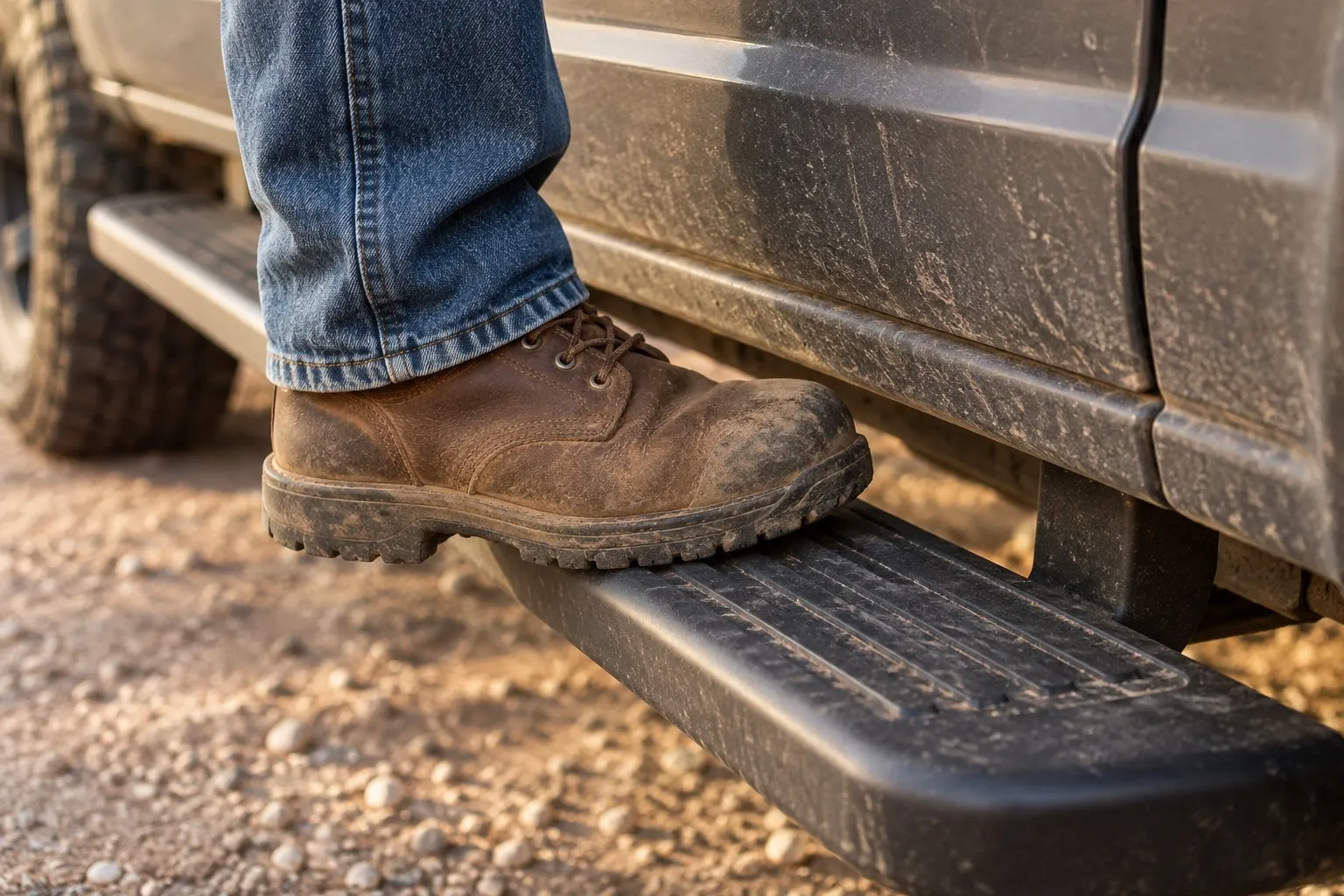
What they are for
A modern pickup sits high, and the first step up is a long one. A running board puts something under your boot on the way up and on the way down. That is the whole job, and everything else is a variation on it.
Some sellers add more claims. Be careful with them. LUVERNE says its Side Entry Steps, which mount high against the rocker panels, add protection from gravel spray, and that is one maker talking about one product. Protection from rocks is a different job, and Rough Country's power board sheet says outright not to use its boards as a rock slider or as skid protection.
Do they carry a set load? There is no shared rating. Westin states 300 lbs. of weight capacity per side for its Pro-e, and many parts state nothing a maker has signed. Read the maker's document for your part.
What the steps on a truck are called
Here is where the common wisdom goes wrong. Plenty of pages say a running board is flat and a nerf bar is a tube, as if the names were rules. On real listings, they are not. Tyger's title for TG-SS2C35068 calls the same part running boards, side step, rail and nerf bars. The shape and width in the title tell you what you are buying, and the name does not.
| Name you will see | What it usually points to | How much to trust the name |
|---|---|---|
| Running board | The general word, often a wide flat step | Low; used for almost everything |
| Side step | The general word again | Low; same part, other word |
| Nerf bar, step bar | Usually a tube or rail | Medium; board titles use it too |
| Drop step | A step section that sits lower than its rail | Fairly high, but read the title |
| Hoop step | Individual steps, not one long board | Fairly high |
| Power step, retractable step | A motorized step tied to the doors | High |
| Rock slider | Protection for the rocker, not mainly a step | Low on Amazon; many are step rails |
| Footboard | Older word for the part, per Wikipedia | Rare on trucks |
Want to go further? Nerf bars vs running boards puts the two most-searched names side by side.
The types, by shape
- Flat board. A wide step, often 6 inches on the titles we read. More room for your boot, more bulk under the door. See truck side steps.
- Tube or rail. A narrower bar, often 3 or 3.5 inches on those titles. See nerf bars.
- Drop step. The step sits below the rail, which shortens the first step up. See drop steps.
- Hoop step. Separate steps instead of one long part. See hoop steps.
- Power step. Comes out when a door opens and tucks away when it closes. It has a motor and wiring, and it takes the biggest install. See power running boards.
- Rock slider. A different part with a different job, though titles blur the line. See what a rock slider is.
Length is a second question. ARIES says cab-length boards run along the cab, while wheel-to-wheel boards go from the front wheel to the rear wheel, across the cab and the bed, and cost more.
Materials vary too. Wikipedia lists aluminum, fiberglass, stainless steel and ABS plastic, and the truck titles we read name aluminum and stainless most. Aluminum vs stainless goes through that choice.
How they mount
Most vehicle-specific parts bolt to points already on the truck, using brackets. Two examples from sheets we read:
- Threaded holes. Tyger's sheet for TG-SS2C35068 uses eight brackets at threaded holes behind plugs along the bottom edge of the body.
- Factory studs. Tyger's sheet for TG-RS6F60118 on the F-150 uses factory studs, with plastic retainers it says prevent corrosion between the aluminum body panel and the steel brackets.
Neither has a drilling step, but that is not true of every kit. RealTruck's guide for the AMP PowerStep 76255-01A calls for drilling through the pinch weld. So read the sheet for your part.
Why every part is truck-specific
The brackets have to meet your truck's mounting points, and the board has to match the length of your cab. So each listing names years and cabs. Cab names do not travel between brands, either. ARIES files the Tacoma Double Cab under crew cabs and the Silverado Double Cab under extended cabs, and it calls that table a guide only. If you are not sure what you drive, start with truck cab types.
A short history
The part is older than the pickup. Wikipedia says the first running boards predate automobiles, with some on carriages as early as the 17th century, and that vintage trams and cars rode much higher than today's vehicles, which is why they were useful. It names the 1929 Ruxton as the first car designed without them. It says they are most common today on SUVs and off-road vehicles, and it does not cover pickups in any depth, so most of what you need comes from truck makers' and part makers' documents.
What to do next
If you are still deciding, are running boards worth it weighs up the downsides. If you are ready to shop, start from the truck picker or all trucks. We print fit only as a listing or maker states it. Check your exact year and cab on the listing before you buy.
Tailgate questions
What are the steps on a truck called?
Running boards, side steps, nerf bars and step bars are all in common use, and sellers use them loosely. A title from Tyger names running boards, side step, rail and nerf bars at once. Drop steps, hoop steps and power steps are narrower names for specific shapes. Go by the shape and width in the listing.
What do they call running boards now?
Mostly the same, plus a few newer names. Truck sellers use side steps, nerf bars and step bars alongside running boards, and power steps for the motorized kind. Wikipedia gives footboard as another name for the part. There is no one official modern name, so search by shape and by your truck.
What is a running board on a car called?
It is also called a footboard, as Wikipedia and Wikidata note. On old cars and trams it was a long step under the doors. Wikipedia says the part is most common today on SUVs and off-road vehicles, and that some cars carry one mostly for looks. On pickups, the sellers' names are side step, nerf bar and step bar.
What are running boards for on a truck?
Getting in and out. They give your boot a place to land between the ground and the cab. Some parts also add a little protection: LUVERNE says its Side Entry Steps add protection from gravel spray. Do not read that as rock protection. Rough Country's power board sheet says not to use its boards as a rock slider.
Do running boards fit any truck?
No. Each part is built for specific model years and cabs, sometimes bed lengths. Boards for a crew cab are not boards for an extended cab, and the same model name can change between years. Listings that claim to be universal still need checking. Match your exact year and cab to what the listing states.
Where this comes from
Keep reading
- ComparisonNerf bars vs running boardsNerf bars vs running boards: usually a 3-inch tube against a 6-inch board, but titles mix the words. What differs, what no maker publishes, and which suits you.
- ExplainerTruck cab typesThere are three truck cab types: regular, extended and crew. Each maker names them differently. See Ford, Ram, GM, Toyota and Nissan names, sizes and door layouts.
- Buying guideSide stepsTruck side steps come as rails, 6-inch boards, drop steps and power steps. Compare styles by year and cab, with fit marked as the listing or maker states it.
- Question & answerAre Running Boards Worth It on a Truck? Benefits, Downsides and Who Can Skip ThemAre running boards worth it on a truck? Yes if the climb is a daily chore. The real downsides, install work and warranty lines, and who can skip them.
- CompatibilityAll trucksWhich running boards fit your truck depends on model, year block, cab and sometimes bed. See the splits listings state for each truck and where to start.
- GlossaryGlossaryRunning board terms in plain English: rocker panel, pinch weld, cab length, wheel to wheel, drop step, DEF tank, Mega Cab and more, with who says so.
Who writes this
runningboardsfortrucks.com Editorial Team
Fitment, buying advice and explainers
We are the editorial team at runningboardsfortrucks.com. We read listing titles, maker pages and instruction sheets, then write down which truck, year and cab each one states and where we read it. We do not run lab tests and we do not own a test fleet, and we say so openly.
- Fit quoted from the listing or maker
- Sources and dates on every page
- No lab tests, stated openly
- Publisher details in the imprint