Explainer
Extended Cab vs Crew Cab: Doors, Rear Seat and Why Running Boards Don't Swap
A crew cab typically has four full-size, front-hinged doors and two full rows of seats. An extended cab has two full-size front doors plus a tighter way into the back: smaller rear doors, or front seats that move forward. The bigger trap is the name on your truck, because makers do not use the same words for the same cab.
Disclosure: This page contains affiliate links (marked with *). If you buy through them, we earn a small commission at no extra cost to you. As an Amazon Associate I earn from qualifying purchases. Learn more
Straight answer
Crew cab: typically four full-size doors and a real back seat. Extended cab: two full-size front doors, with smaller rear doors or a seat-forward layout and a tighter back seat. Names change by maker: SuperCab and Quad Cab sit in the extended group, SuperCrew in the crew group, and Double Cab lands in either one depending on the truck. Boards are sold per cab, so they do not swap.
The short version: crew cab means more room for people, extended cab means less back seat and often more room for bed. Here is how the ARIES cab guide lays it out. ARIES says plainly that its groups are there to help you understand, and that they do not mean the trucks share a design.
| Extended cab | Crew cab | |
|---|---|---|
| Front doors | At least two full-size, front-hinged | Two full-size, front-hinged |
| Way into the back | Smaller rear doors or front seats that move forward | Typically two more full-size, front-hinged doors |
| Back seat | Often small or jump seats; can lack legroom and headroom | Two full rows, seating for up to five or six |
| Rear windows | Typically a smaller set behind the front windows | Not called out by ARIES |
| Bed | Varies by truck | Often shorter, to make room for the cabin |
| Cost | Often less than a crew cab | Generally the most expensive of the three |
One more note from ARIES on extended cabs: the rear doors may only open after the front doors are open. That matters in a tight parking spot, and it matters for where a step sits.
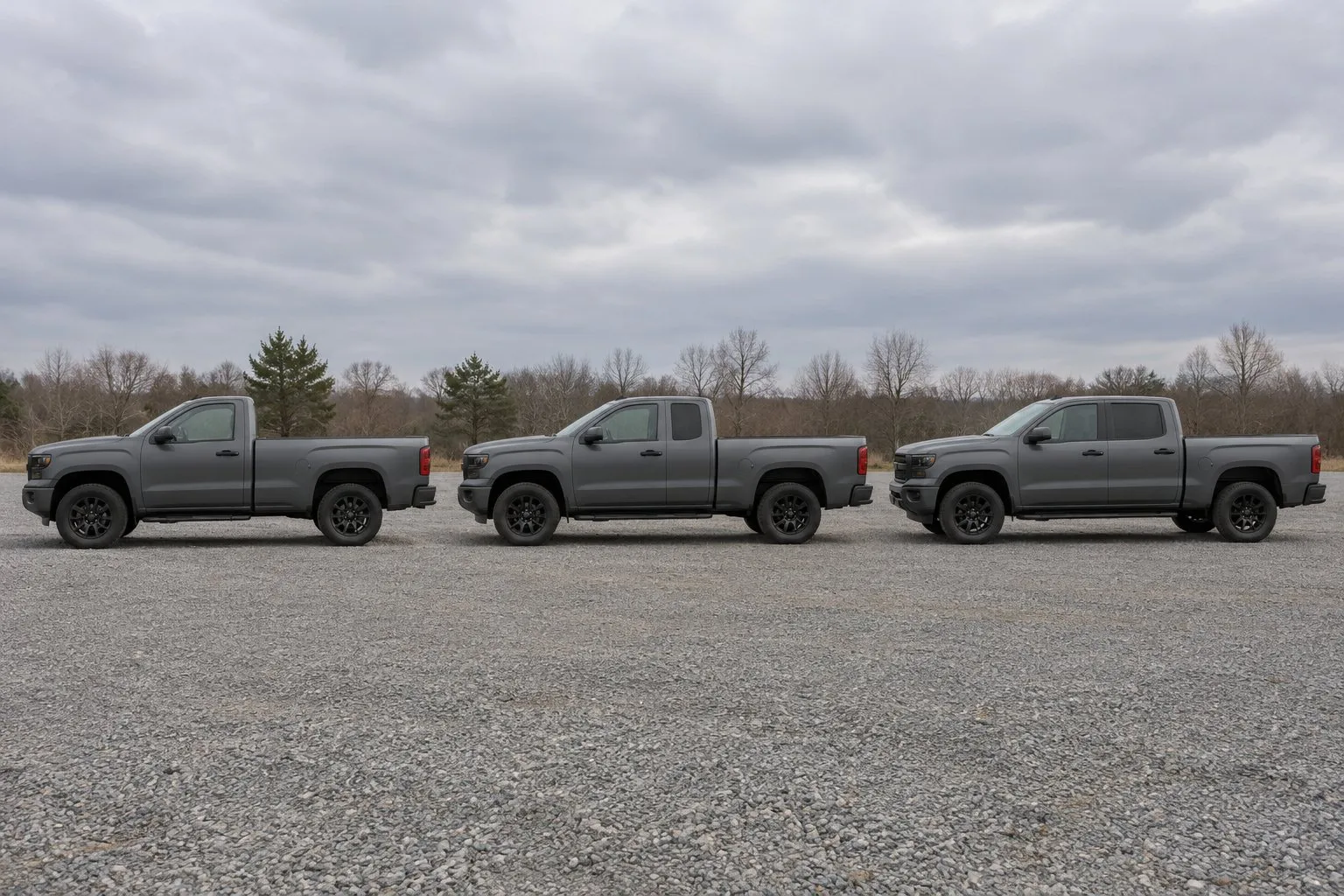
Who calls what: cab names by maker
This is where most of the wrong orders start. A cab name is the maker's choice, and the ARIES table shows how far apart those choices are.
| Truck | Extended group | Crew group |
|---|---|---|
| Chevrolet Silverado, GMC Sierra | Extended (before 2004), Double (2014 to current) | Crew |
| Ford F-150 | SuperCab | SuperCrew |
| Ford Super Duty | SuperCab | Crew |
| Ram 1500 | Quad | Crew |
| Ram 2500, 3500 | None listed | Crew and Mega |
| Nissan Frontier, Titan | King | Crew |
| Toyota Tacoma | XtraCab (1995-2004), Access (2005 to current) | Double |
| Toyota Tundra | Access (2000-2006), Double (2007 to current) | Double (2004-2006), CrewMax (2007 to current) |
Two things to read out of that table. First, Ford's SuperCab and SuperCrew sit in different groups, so one is not a stand-in for the other. Second, one word, Double, shows up in both columns.
"Double Cab" depends on who built the truck
Do not let anyone hand you one meaning for it. Take it maker by maker.
Chevrolet Silverado and GMC Sierra. ARIES files the Double Cab under extended. Chevrolet's own trucks page lists the Silverado and Silverado HD as Regular Cab, Extended Cab and Crew Cab. So the same cab wears two names, and at least one listing title for 2007-2018 GM trucks uses both in a single line. We did not find a Chevrolet text that describes the rear doors, so look at yours.
Toyota Tacoma. ARIES files the Double Cab under crew. Toyota sells the 2026 Tacoma as XtraCab or Double Cab and lists seating for up to five on the Double Cab only. It describes a fold-flat passenger seat and a lockable rear storage panel on XtraCab models. The ARIES table still shows Access for current trucks, while Toyota and the newer listings say XtraCab. See Tacoma running boards for how the listings split.
Toyota Tundra. This one moved inside one truck line. ARIES puts the 2004-2006 Double Cab under crew and the 2007-to-current Double Cab under extended, with CrewMax taking the crew spot. One 2026 trim summary on Toyota's page shows Double Cab with a 6.5-foot or 8.1-foot bed and CrewMax with a 5.5-foot bed. Tundra running boards covers the CrewMax and Double Cab listings.
How to tell which cab you have
Count the doors
Two doors means a regular cab, or an extended cab with a seat-forward layout. Check for room behind the front seats.Compare front and rear doors
Rear doors that match the front in size point to a crew-type cab. Clearly smaller rear doors point to an extended-type cab.Open only the rear door
If it will not open until the front door is open, ARIES describes that as an extended-cab trait.Use the maker's name
Your window sticker or a dealer can give you the exact cab name. That name is what the listing will use, so match it word for word.
Why boards for one cab don't go on the other
A board bolts to mounting points along the cab, and it has to span the doors it serves. Change the cab and both of those change. Each part is built for specific model years and cabs, sometimes bed lengths.
The clearest numbers we have come from a maker. RealTruck's install guide for the AMP PowerStep 76255-01A, for 2022-up Silverado and Sierra 1500 trucks, uses one board assembly and cuts it by cab: 79 inches for a Crew Cab, trimmed 10 inches to 69 for a Double Cab, trimmed 29 inches to 50 for a Single Cab. That is 10 inches of difference between two cabs on the same truck line.
Listings split the same way. Ram older-body boards come as separate crew and Quad Cab titles. F-150 boards we read name the SuperCrew, so the F-150 page treats the SuperCab as its own question. The Silverado page keeps Crew, Double and Regular apart. On those pages, the fit line shows what each listing states. Check your exact year and cab on the listing before you buy.
Where the bed comes in
Cab-length boards run along the cab, so the bed stays out of it. Wheel-to-wheel boards run from the front wheel to the rear wheel and cost more, according to ARIES, and that ties them to bed length too. Bed and cab fitment walks through how to read those titles.
Beds also vary by cab on the same truck. Ford's 2026 F-150 specs show the Regular Cab with a 6.5-foot or 8-foot box, the SuperCab with a 6.5-foot box and the SuperCrew with a 5.5-foot or 6.5-foot box. Chevrolet lists the Silverado with 5'8", 6'6" and 8'1" beds and the Silverado HD with 6'8" and 8'1", without tying them to a cab on that page.
Which one should you get?
If you are choosing a truck, the call is simple. People ride in the back most days: crew cab. People ride back there now and then, or you want gear locked inside and more bed: extended cab. ARIES adds that crew cabs generally cost more and often give up bed length, and that extended cab back seats are often cramped for taller riders. It also says crew cabs tend to use more fuel; we have no measured figure for that, so we print none.
If you already own the truck, the only question is what is listed for it. Start with your truck below. When you are ready to compare parts across trucks, the best running boards page lists our picks by truck, and how we verify fitment explains what those fit lines are based on.
If you drive a Silverado or Sierra with a Crew, Double or Regular Cab
If you drive a Ram 1500 with a Crew or Quad Cab
If you drive an F-150 with a SuperCrew, SuperCab or Regular Cab
If you drive a Tacoma with a Double, Access or XtraCab
If you drive a Tundra with a CrewMax or Double Cab
If you drive something else
Tailgate questions
Is an extended cab the same as a crew cab?
No. In the ARIES cab guide, an extended cab has at least two full-size front doors, with the back seat reached by moving the front seats or through smaller rear doors. A crew cab typically has four full-size, front-hinged doors and two full rows. ARIES calls the groups a help for understanding, not a design spec.
Is a double cab the same as a crew cab?
It depends on the truck. ARIES files the Tacoma Double Cab under crew. It files the Silverado and Sierra Double Cab under extended, and the 2007-up Tundra Double Cab under extended too. Go by the maker's name for your truck and by your own rear doors, not by the word Double.
Is a Toyota double cab the same as a Chevy double cab?
No, not in the ARIES table. The Toyota Tacoma Double Cab sits in the crew column and the Chevrolet Silverado Double Cab in the extended column. Toyota's own Tundra is split as well: its 2004-2006 Double sits under crew, its 2007-up Double under extended. A board listed for one is not a board for the other.
Do crew cab running boards fit an extended cab?
Do not count on it. Listings name the cab, and the cabs differ in length and door layout. RealTruck's guide for its 2022-up GM PowerStep makes the point in numbers: 79 inches for a Crew Cab, trimmed to 69 for a Double Cab. Buy the listing that names your cab, then check your exact year and cab on the listing before you buy.
How do I know which cab I have?
Count the doors, then compare them. Four doors of about the same size point to a crew-type cab. Short rear doors, or no rear doors and a seat that moves forward, point to an extended-type cab. Then use the name your maker gives that cab, which is what the listing will use. Your window sticker or a dealer can confirm it.
Where this comes from
Keep reading
- CompatibilityAll trucksWhich running boards fit your truck depends on model, year block, cab and sometimes bed. See the splits listings state for each truck and where to start.
- ExplainerCab and bed fitmentCab length running boards run along the cab, wheel-to-wheel boards run to the rear wheel. How cab names and bed length decide fit, and how to read a listing title.
- ComparisonBest running boardsThe best truck running boards are the ones listed for your year and cab. Our picks by truck and use, with no lab scores, only published fit and maker sheets.
- CompatibilityFord F-150F-150 running boards by year and cab: SuperCrew, SuperCab, Regular. What the titles state, what Ford's sheet says about the body, and factory vs aftermarket.
- CompatibilityToyota TundraToyota Tundra running boards by cab and generation. CrewMax and Double Cab are separate listings, and 2022-up trucks are separate again. Fit as the titles state it.
- About usHow we verify fitFit here is what a listing title or maker sheet states, marked as such. What we read, what blocked us and why you still confirm year and cab before you buy.
Who writes this
runningboardsfortrucks.com Editorial Team
Fitment, buying advice and explainers
We are the editorial team at runningboardsfortrucks.com. We read listing titles, maker pages and instruction sheets, then write down which truck, year and cab each one states and where we read it. We do not run lab tests and we do not own a test fleet, and we say so openly.
- Fit quoted from the listing or maker
- Sources and dates on every page
- No lab tests, stated openly
- Publisher details in the imprint